Posts

Galactic Centre

A portrait of the Milky Way

Download Portrait (9x16) version

Download Landscape (16x9) version

This is a supermassive black hole – the galactic centre of our galaxy, the Milky Way. I was able to photograph it on Thursday night around 10.30pm from a field in Grabouw using my trusty Fuji X-T2 and a 16mm lens at f/1.4. 30-seconds of exposure at ISO 400. A perfectly clear sky but a touch of wind – though the tripod seems to have done its job. No Photoshop. Just RAW processing in Lightroom for white balance, contrast and exposure.

Fantasy

Week 21 of my #52photos2017 project

This week’s photo is of a jungle planet in a galaxy far, far away. Probably.

Or maybe its the futuristic and fantastical landscape of Gardens at the Bay, Singapore. Difficult to tell.

Messy

Week 19 of my #52photos2017 project

This week’s portrait is of a very messy toddler enjoying a chocolate ice-cream that his parents shouldn’t have given him.

Urbanscape

Week 17 of my #52photos2017 project

One of my favourite “urbanscapes” in the world – Singapore’s downtown taken from Marina Bay at sunrise. I was fortunate to be back in Singapore this week, but didn’t manage to capture the scene, so this is a shot from January 2017.

Movement

Week 16 of my #52photos2017 project

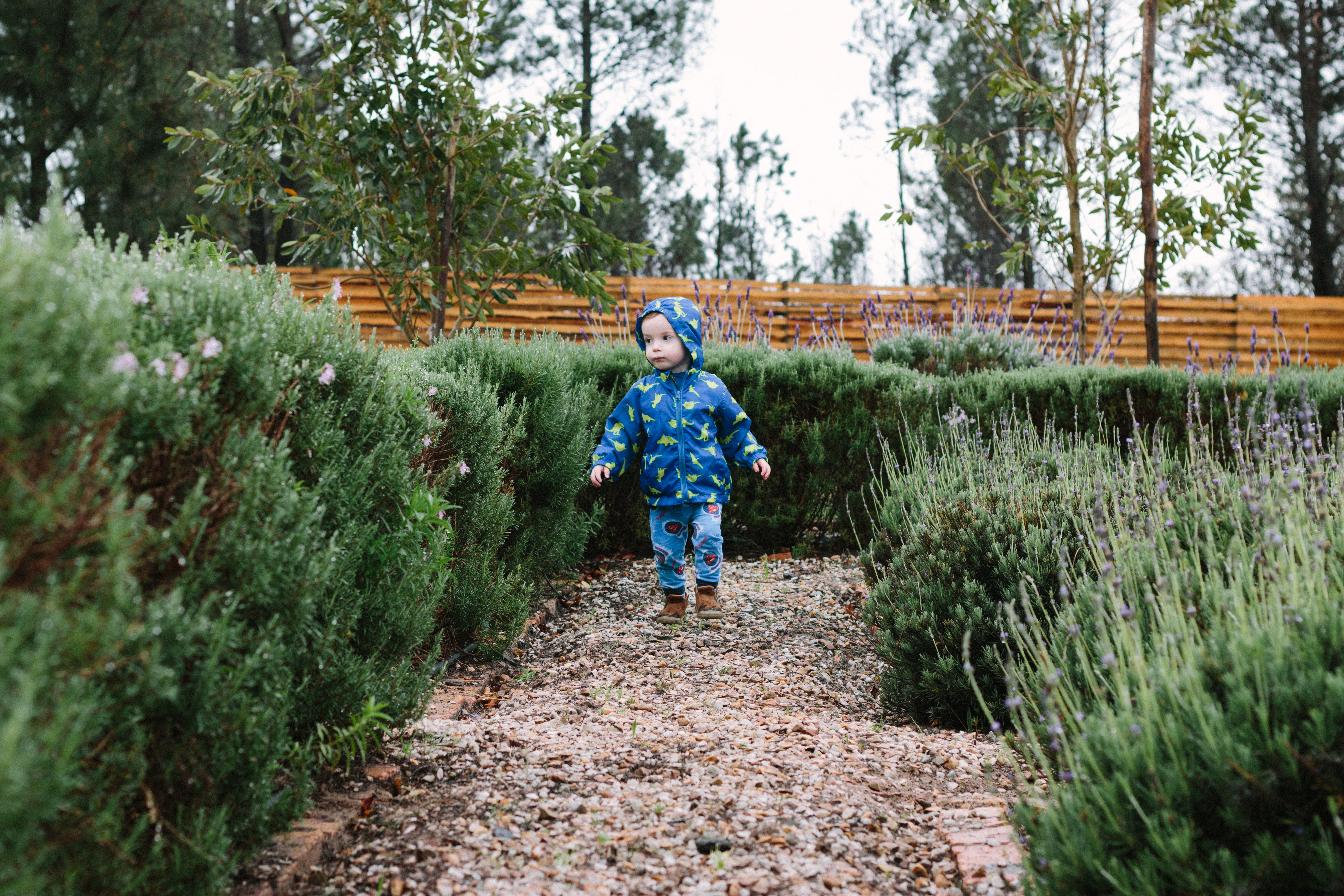
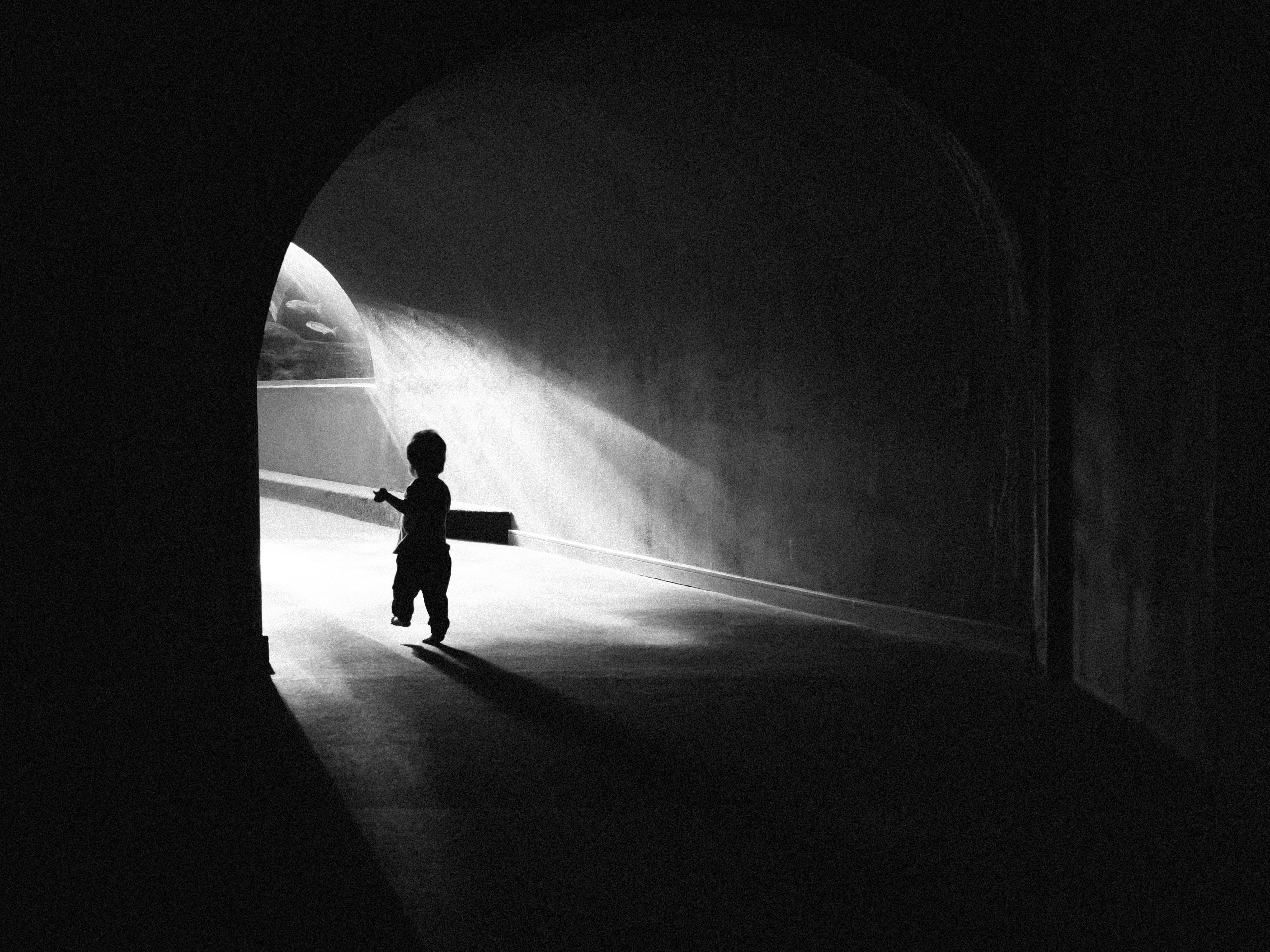
Week 16 is a celebration our little guy’s first real walking outing. We took him to the Two Oceans Aquarium and he just loved it (the walking, he was a bit ambivalent about the fish).

Metal

Week 15 of my #52photos2017 project

Week 15’s theme is ‘metal’. We bought this decorative globe from a street trader years ago and it’s starting to rust. Shot with the wonderful Canon 100mm f2.8 Macro lens.

Zoomed Landscape

Week 14 of my #52photos2017 project

This week’s challenge was to shoot a landscape with a long telephoto lens. I’m quite pleased with the result – rows of vines in Constantia.

She waits

Week 12 of my #52photos2017 project

This week’s challenge was to find inspiration in transportation. But I had an incredibly busy week and didn’t manage to take a good photograph. So this one is from my failed attempt to take a photo each day in 2014. It counts, right? It’s one of my favourite photos.

Dexter's Lab

Week 10 of my #52photos2017 project

This week’s challenge was to show a subject in their natural habitat. Well, this is Dexter. He’s the Pipeline Supervisor at work and is the glue that holds everything together. His office is a fort made of LCD monitors.

Shadows

Week 9 of my #52photos2017 project

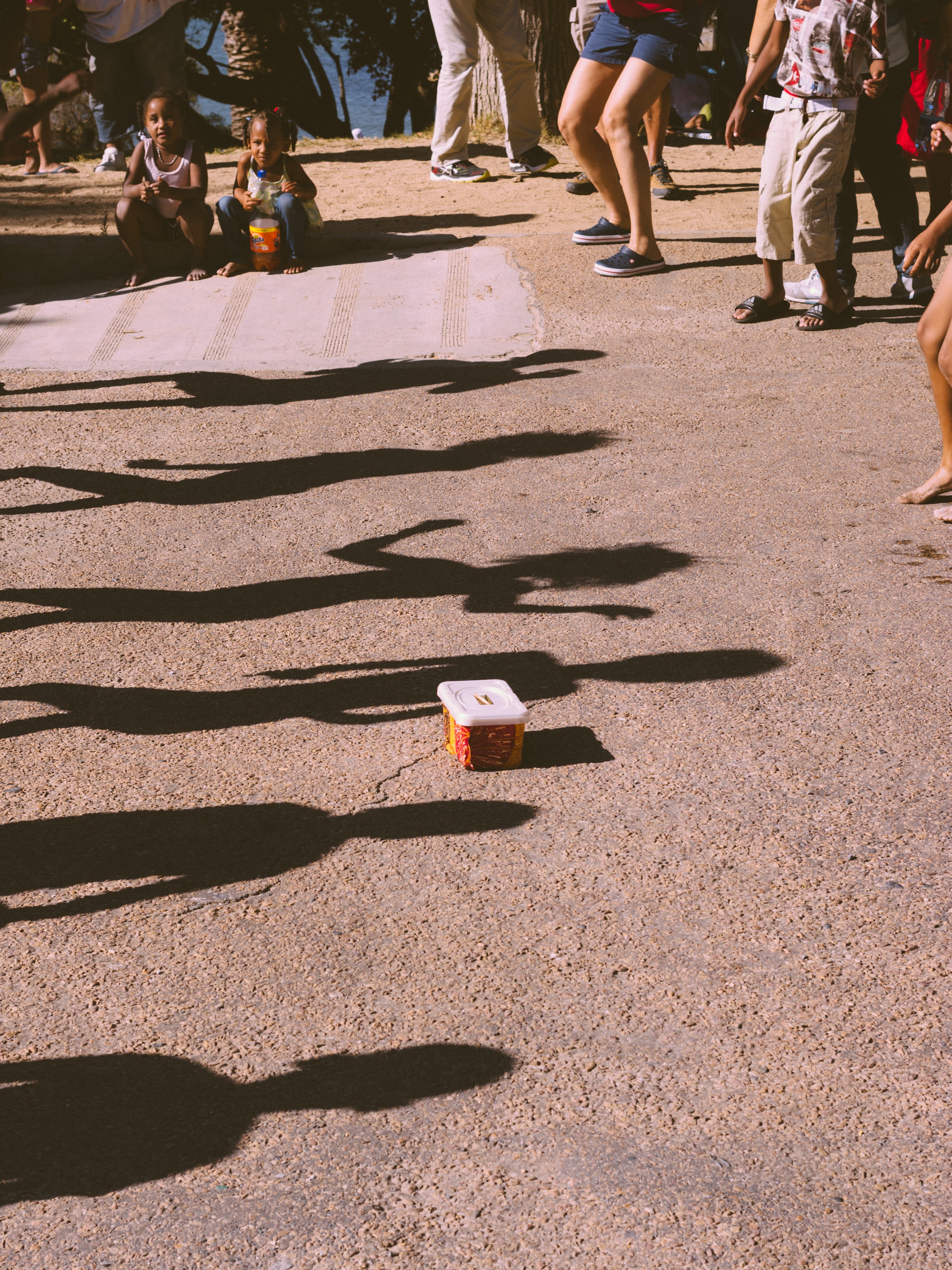
Children from a nearby township sing and dance to raise money. Tourists and locals alike are captivated by their energy, as the late afternoon sun casts their shadows across the car-park.

Panoramic

Week 8 of my #52photos2017 project

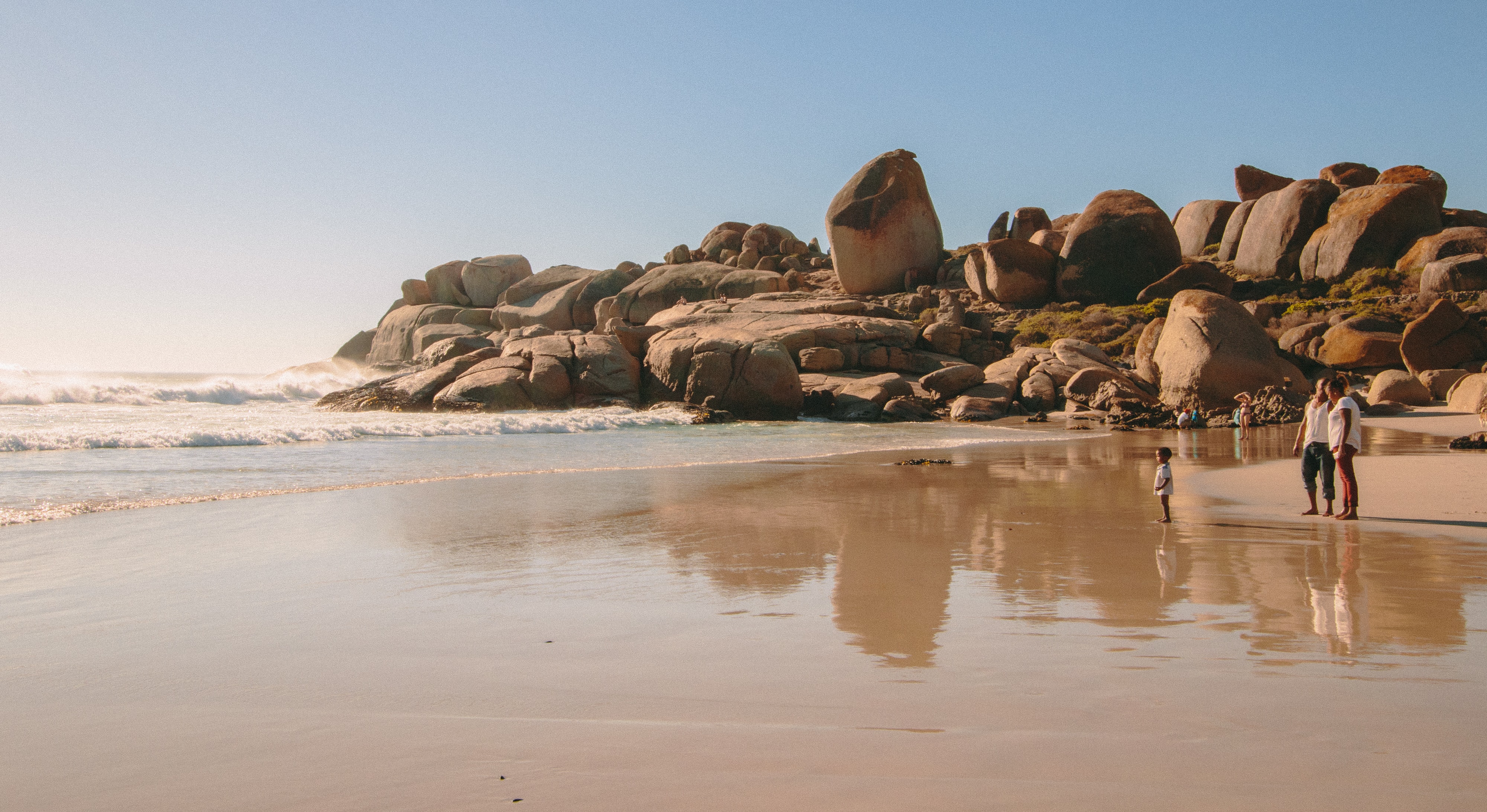
This week’s photo is an uncomplicated shot of my favourite view in the world. This is Kommetjie. It’s where I spent the first 22 years of my life. This week’s challenge was to shoot a panoramic landscape. I (well, Lightroom) stitched together three individual shots to create this image.

Faceless

Week 7 of my #52photos2017 project

I’ve been taking an Uber to and from work this week. I’ve made small talk with a lot of drivers. The conversation usually follows the same pattern: A greeting. Some pleasantries or a comment about the weather. A brief conversation about Uber itself. And then its out the car, and they’re off.

This week’s theme was Faceless – “tell someone’s story without showing their face”. I was struck by the transient relationships we set up and tear down each day as we move through the world. These Uber drivers have been my lifeline this week, and yet I don’t remember their name – or face – within 10 minutes of meeting them.

Candy

Week 6 of my #52photos2017 project

This week’s theme was Candy. Now I don’t tend to have a sweet tooth… but Turkish Delight is my guilty pleasure.

I had such fun taking this week’s photo using the Godox Diffusion Box from ORMS. It’s affordable and provides a super portable space for product photography at home.

Berg River Dam

Week 5 of my #52photos2017 project

The Western Cape’s dams are at 38%. Levels are falling at around 1.5% per week as the region enters the hot months of February and March.

This week’s theme is Black and White Landscape. I took a drive to Franschoek to shoot the Berg River Dam. It fell below 50% last week. Along with four other dams, it supplies Cape Town with water for residential, industrial and agriculture purposes. We’re already at Level 3 “B” water restrictions. Unless something changes soon, we’re in trouble.

Babychino Portrait

Week 4 of my #52photos2017 project

We were in London this week for Amy and my father to attend the Apple Education leadership series. Ben and I took Granny to breakfast on her birthday. Here’s a post-babychino Benjamin in a Coppa Club pod on the Thames.

Red

Week 3 of my #52photos2017 project

I’m in Singapore and this week’s theme is red. Which is perfect because, with Chinese New Year next week, there is no shortage of red around the city. I took a walk to China Town to photography my favourite coffee shop: Nanyang Old Coffee.

Self Portrait

Week 1 of my #52photos2017 project

It’s week 1. This is me in my office with my hipster lights. I love them.

52 Photos

Happy New Year. I’m really excited about 2017. It’s a prime number… oh, and I’m turning 30. Big year! I’ve spent the past few days thinking a lot about the year ahead and my goals for it. I don’t believe in New Year’s resolutions (because they don’t work) but I do enjoy the opportunity to review the last 365 days and plan the next.

In terms of creative focus, I’ve decided that I want to take more (and more interesting) photos. In 2014, I tried to take one photograph a day for 365 days. It started out well. I shot and posted for 52 consecutive days and then I gave up. Ultimately, it was just too much of a challenge to shoot, edit (obsessively) and post every single day.

In 2017, I’m trying something different. 52 photos, one per week, with a different theme each week. Chris Cunnington introduced me to Dogwood Photography’s 52 week challenge and I’m going to do it.

The schedule cycles through three broad areas of photography: Portrait, Landscape, Artistic. Each week there’s a different specific theme that touches on one of these topics. For example:

  • Week 1: Portrait – Self Portrait
  • Week 2: Landscape – Traditional Landscape
  • Week 3: Artistic – Red
  • Week 4: Portrait – Headshot
  • Week 5: Landscape – Black and White
  • Week 6: Artistic – Candy

If you’d like to join me, I’ve made an OmniFocus-compatible Taskpaper file, a public Google Calendar and a CSV file of the challenges.

I’ll post my photos here, on Instagram and Twitter. Keep me honest.

8 Links for Jan 15th, 2016

Remembering Bowie, Rickman, Obama and (yes) Star Wars.

It’s the terror of knowing
What the world is about
Watching some good friends
Screaming ‘Let me out’
Pray tomorrow gets me higher

  • A very sad week. We lost two absolute titans: David Bowie and Alan Rickman. Bowie died just two days after releasing ‘Lazarus’ from his final album ‘Blackstar’. The Telegraph called it a ‘parting gift in a cleverly planned finale’.
  • Alan Rickman, the award-winning actor famous for playing Professor Snape in Harry Potter and Hans Gruber in Die Hard, passed away at age 69. He too had been suffering from cancer. Whether on film or the stage, his distinct voice and presence were unmistakable. BBC News shared early responses from his friends and family.
  • President Obama delivered his final State of the Planet Nation address. His speech set out a vision for the future and looped back around to his core concept of the ‘politics of hope’. Vox Media has a great 4-minute edit of the hour-long speech.
  • Netflix has rolled out internationally, but NBCUniversal says they don’t feel threatened. Alan Wurtzel says he doesn’t “[…] believe there’s enough stuff on Netflix that is broad enough and consistent enough to affect us in a meaningful way on a consistent basis.”
  • I promise I’ll stop talking about Star Wars after this (no I won’t) but you have to read VFX Supervisor Roger Guyett’s interview with Studio Daily. It’s a fascinating discussion of how they balanced practical and digital effects in The Force Awakens.
  • Apple has unveiled bold new plans for iOS in Education. This is huge news for schools using iPad in the classroom. Catch this special episode of the ‘Out of School’ podcast for more information.
  • And finally, Stephen Fry welcomes us to the UK. Perfectly British.

8 Links for Jan 8th, 2016

Star Wars (of course), some Penguins, MTV's Shannara and the iPad.

Each week, I’ll post eight links that I’ve read and enjoyed in the past week. They’re not intended as a summary of the week, or a particular comment on the news. They’re just things I found interesting. With that, here is the first edition of 8 Links.

  • The so-called white slavers at Disney have successfully guided Star Wars: The Force Awakens to be the highest grossing movie of all time. This is the first time in 18 years that a James Cameron movie hasn’t held the top spot.
  • Meanwhile, Matty Granger delivered an absolute smack-down in rebutting that Huffington Post article about ‘Force Awakens’ plot holes. It’s beautiful.
  • The Penguins of Madagascar explain the intricacies of Dreamworks Animation Studios production pipeline.
  • Polygon says MTV’s Shannara Chronicles is the next Game of Thrones. Critics appear underwhelmed.
  • Fraser Speirs has sold his MacBook Pro and gone all-in on the iPad Pro. He’s also launching a new podcast later today with Federico Viticci about the success and challenges of using iOS as your primary computing platform. I listened to a preview of Episode 01 last week – you’re gonna want to subscribe to this one.
  • Speaking of iOS and apps, Robleh Jama has described how he’s using Medium as a place to present Press Kits for his apps. Smart move.

Have a great weekend!

Traveling and photography

These photo stories are the perfect coalescence of my passions: design, development, travel and photography.

Paul Stamatiou’s beautiful photo essays are a major influence.

I'm a Dad

Internet, meet Benjamin Miles Keller. Born 2.9kg at 21:07 tonight. Both he and mom are doing well. Now excuse me while I just stare at him forever.

I'm going to be a father

I’ve been looking forward to writing this blog post for the past two years. Today I get to announce that I’m going to be a father. And it’s going to be a boy!

Medical stuff is hard and it’s been a long journey to get here, but with a 20-week-old baby growing inside Amy we can finally breath a momentary sigh of relief. This is real. Here he is (he’s a bit grainy at this stage… but you get the idea).

Create Thoughts

It’s May 2015 and this is the first post I’ve written in a year.

That’s not to say I haven’t been writing – I have. Each day I produce thousands of words of riveting email, and most weeks I land up writing proposals and presentations. These are things with words… with some degree of creativity. But I haven’t really written. And if I’m really honest with myself, I haven’t written anything good in years.

The last time I published something it was announcing that I was going to take a photograph-a-day for 365 days. You might have noticed that I only made it to Day 52 before failing dismally. Consistency is hard.

My blogging history is littered with bold starts that quickly fizzle out. Far too many of my blogging seasons begin with “Just moved to Wordpress” or “I’m moving to Jekyll”. The tools are fun (to a nerd) but the grind of publishing is not. Yet the few times that I’ve written about something I actually care about have been an amazing feeling. There’s nothing quite like passionately putting a well (or poorly) considered idea out into the world.

In the past I’ve published to timkeller.me. That ends today with the move to cre8thoughts.com. This is one more fresh start. There’s a good reason for this, and there’s a good reason I’m so excited about writing at this slightly silly new domain. I’ve always been a bit self-conscious about writing at a blog that shares my name. My name tells my reader absolutely nothing about the general theme and topic of the blog. One month I’m writing about education, the next I’m linking to articles about Apple, and then I’m writing about programming languages. It’s too scattered.

So why cre8thoughts? I’m fascinated by the things that create and shape the thoughts and ideas and obsessions we have. Our thoughts are the sum and average of the inputs we expose to our minds. If thoughts are the photography film, then these inputs are the light entering the lens. Focussed with care, these inputs can develop into incredible products, novel solutions and clever businesses.

This is a journal of these inputs and of how they shape the things I make. Expect a diverse set of topics, but I will try my best to keep the focus on this core idea of: creating thoughts worth thinking about.

365 days of photos

Tomorrow I’ll take a photograph of something I see, import it into Lightroom, agonise over it for hours, export and upload it to a website. The following day I’ll do the same thing. And the day after that.

And every day until 30 June 2015. Three hundred and sixty five photographs in as many days.

Why?

  1. Community. My friends and colleagues at Sunrise undertook this challenge last year. David set up a site and folks posted their work there. Many of them are redoing the challenge this year, and I feel like joining them.
  2. Practice. I want to exercise the photograph-making muscle more regularly. Weeks can go by without my fairly nice camera 1 being taken out its bag.
  3. Consistency. Dan Benjamin often remarks that the secret to success is showing up consistently and doing what you said you’ll do. Well, outside of the most mundane of daily tasks, I can’t think of anything I’ve done consistently for an entire year. This is a test to see if I can change that.

I’m scared.

  1. I shoot a Canon 650D with a couple of entry-level Canon lenses. Current favourite is the EF 40mm f/2.8. 

My First Mac

I often feel a pang of regret that I came to the Mac so late in its return to popularity. My corner of the internet is littered with epic stories of the Mac in the 80’s, heroric tales of the dreadful 90’s and the renasiance from ‘97 into the early 2000s.

I grew up in the early 90’s in Cape Town. While the Macintosh was not doing well globally, it was doing even worse in South Africa. Apple had pulled out of the country in 1985 as a result of the then government’s policy of apartheid making them difficult to find and very expensive.

Our house had a IBM PC clone with a monochrome orange screen running MS-DOS 5. It was at that blinking “C:>” DOS prompt that I developed a love for computers. I typed up projects in Word Perfect 5.1 and studied the “toolbar” that my father had attached to the top of our keyboard. It wad three rows and twelve columns. The rows represented the modifer keys CTRL, ALT and SHIFT, while the columns were aligned with the “F” function keys. I learned to spell through playing Space Quest and Police Quest… and King’s Quest! I made a menu appear at startup through what I thought was some impressive autoexec.bat hackery.

But as I read Stephen Hackett and John Siracusa detailing their early and formative experiences with the Macintosh, I can’t help feeling like I missed out. What I do know is that there was something deeply formative about learning DOS on that clunky PC clone. I remember bawling my eyes out when I had to tell my mom and dad that I’d accidentally run RD C:/ and formatted the entire drive. I remember the feeling of finding QBasic for the first time.

Years later I would use a Mac for the very first time. It was 1999 and we were at Legoland during a family holiday to the UK. My dad had booked my brother and I into the Mindstorms Programming Class.

Yeah, when your parents are teachers, you’re going to be coerced into something educational wherever you go!

We sat down at these funny looking computers and were shown around. I was floored. The monitors where blue in colour and semi-transparent, the mouse was this funny round disc and I couldn’t figure out where the tower was hidden. The software looked unlike anything I’d ever used, but oddly familiar. I’d seen these windows and icons in computer books at the library. That afternoon we programmed Lego robots to drive around the room, pick things up and make sounds. And we did this all from an incredible little Apple computer.

Eight years later I finally bought my first Mac. It was a late-2007 Macbook Pro. I was in my third year of university studies and used up every last cent of my savings to buy it. This was before the era of unibody construction, button-less trackpads and solid state drives. It had a 15” glorious matte screen, a screaming-fast Intel Core 2 Duo and Nvidia graphics. Driving home I wondered if this machine had been worth all that money.

And then I kinda never wondered again.

Rebooting

Most years I spend a couple of days in December planning for the year ahead. That process usually results in a blog post detailing my broad goals and ideas for the year ahead. This year is a bit different.

After five years at Umoya and seven years working on Staffroom full-time, I’ve found myself facing a fresh start in a completely new job and in a totally different industry. I’m now working at Sunrise Productions as a Senior Developer.

Initially I’ll be helping the CG Pipeline team with some tools development - specifically for Maya and Houdini. New, unknown, exciting. It’s a massive change, but I must admit that my first week has been fantastic. Sometimes the most uncomfortable decision turns out to be the best decision.

So here’s to the next chapter…

Update 2014-05-18: Staffroom was sold to EiffelCorp in April 2014.

Some Freedom

Thanks to Derek Keats, it has emerged that the South African Department of Basic Education has selected Microsoft Office as the exclusive teaching environment for the high school computing course, and Delphi as the programming language for the programming subject.

There’s so much obviously wrong with this decision that it feels degrading to even participate in the debate. Honestly after reading Circular S9/2013 I physically pinched myself to check whether I was dreaming. Unfortunately I was not.

Effectively, schools using OpenOffice, LibreOffice and older versions of Microsoft Office will have to upgrade to Office 2010 or 2013. Schools currently teaching Java will have to switch to Delphi from next year so that the 2016 Matrics can write the NSC exams. Both of those software packages carry proprietary, closed-source licenses.

This while the SA Government continues to boast about its Free and Open Source (FOSS) Policy. Actions speak louder than words, folks.

This “Delphi” thing

Embarcadero Delphi is a Windows (only) application that compiles programmes written in the Object Pascal language. Depending on your age, you may have been taught Turbo Pascal at school in the 1970’s and 1980’s. Pascal itself is a descendant of a language called ALGOL 60, developed around 1960 for mainframes.

The company that currently owns Delphi does not charge license fees to South African students. But this is hardly a guarentee in perpetuity, and Delphi has changed corporate ownership a few times in the past decade.

On the other hand, consider the free and open languages that are thriving in academic environments, scientific applications, mobile, web, enterprise and embedded:

  • Javascript: Free and built into every web browser.
  • Python: Free, Open Source. Massively popular across industry.
  • PHP: Free, Open Source. The language behind many websites (like those running Wordpress) and web applications.
  • Java: Free, Open Source. Android apps are written in a dialect of Java.
  • Objective-C: Free via the Mac App Store, builds on C/C++. iPhone, iPad and Mac apps are commonly written in Objective-C.
  • Ruby: Free, Open Source. Many websites and web applications use Ruby. The free and Open Source Ruby on Rails web framework is very popular.
  • C/C++: Free, Open Source implementations. Hugely powerful and widely used in Operating Systems, Games, Drivers and Server software.

Teaching programming

While I am suggesting that Delphi is a poor choice of language, its not because its old, unpopular, outdated or boring. Though, those reasons may be valid. My problem is that Delphi is a closed-source, commercial, proprietary software package that by definition of its business model, needs to keep people using Delphi and Delphi alone.

I taught IT to High School students for two years during my Computer Science degree. Our school happened to use Java… but I frequently exposed my class to other programming environments and languages. Because that’s how the world works. Humans communicate in a multitude of different dialects and languages.

Its astounding to me that, in 2013, a national department of education can reach the decision to mandate a single programming language. Across the world, education systems are embracing a “use any language” philosophy and instead focusing on assessing how students use that language to solve problems.

No professional developer today is spending all their time in one programing language. In fact, even a junior web developer would regularly find themselves programming in HTML, CSS, Javascript and PHP or Python simultaneously.

Where to from here?

It is clear to me that the IT subject is no longer a viable choice for children interested in computers and programming. In attempting to defend their position, the DBE admitted that:

“Only 0.9% of Grade 12 learners take IT and 9% of Grade 12 learners take CAT.”

As passionate members of the IT industry and concerned educators, we need to take matters into our own hands.

There’s a fledgling community of programming courses and workshops for children. Some of them are offered regularly, others are short courses. We need to create more of these, and attract children to try their hand at programming apps, websites and online services.

2012 in review

I loved this year. That’s not to say it wasn’t extremely difficult at times, or that some singular great thing happened. It was just a really good year.

I wrote at the end of 2011 about my goals and objectives for the year, and they were fairly audacious.

This year at Umoya we re-wrote most of staffroom, released more than 200 features and tweaks, migrated to cloud servers, and switched from Subversion to Git. We reinvigorated our brand, redefined our purpose, built some amazing new relationships, and signed a few of large deals. We finally updated our website, hired some wonderful new people and deployed our first two international sites.

At EdTechConf we hosted two ThinkShop events - a Tablet Indaba at the International School of Cape Town, and a great community event at Rondebosch Boys’ High. We re-organised the leadership team and made a new website.

Personally, I finally got diagnosed with ADHD, implemented the right treatment, had my (long overdue) wisdom teeth extraction, took on more responsibility at Umoya, bought a new house, welcomed a furry friend into our family, and celebrated three years with my wife.

At the outset, my goal included many of these things. They also included a few things I didn’t achieve: writing once a week for this blog and starting a podcast focussed on education technology. I managed to publish just 35 posts and several of them were brief comments or links, and I recorded just one podcast about Windows 8.

As I set new goals for 2013, I’m acutely aware that my list already contains more items than I’ll have time to do. Indeed the best goal I could choose for 2013 would probably be to learn a more judious approach to allocating my time and attention.

Here goes.

House 2.0

Signed, initialed, dotted and crossed: we’ve just bought our second house (and sold the first). The whole process has been daunting and - at times - terrifying but ultimately has been a great adventure. Lessons learned: banks are mostly terrible, good estate agents are a lifesaver, and lawyers cost a lot of money because they do really painful work on your behalf.

We’ve lived in our first home since we got married three years ago. It has been a great start for us. Compact, easy, manageable. We wanted to get into the property market from day one, and our little duplex townhouse gave us that. I wouldn’t change anything.

House 2.0 has more rooms, more garden, a great kitchen, dining room and lounge. Its in a nearby neighbourhood and so we won’t have to reconfigure our travel routines too much. I think we’ll live there for several years.

The One Classroom

Imagine a school that provided high quality education to anyone who wanted it. Whether young or old, rich or poor, its doors would be open 24 hours a day. Imagine that it provided instruction on topics from basic mathematics to vector calculus. From chemistry to astronomy. Microeconomics to Healthcare. Imagine that this school held a million students and provided them with more than 150 000 lessons each day on nearly 4000 different topics.

Now imagine that this isn’t some utopian and futuristic pipe dream. Its real. Welcome to the KhanAcademy – a global classroom of students learning almost anything, for free.

The KhanAcademy is the brainchild of Salman Khan, a former hedge fund analyst and Harvard MBA. Khan began teaching Maths to his younger cousins who lived in a different city using Yahoo Doodles – a whiteboarding website which allowed him to teach them in real time.

After finding some success with this approach, he began recording additional lessons – complete with audio and photos to illustrate his points – and uploaded them to YouTube where they could watch them at their leisure. That’s when he made two surprising discoveries:

First, his cousins told him that they no longer wanted him to tutor them “live” as they preferred it when he recorded himself. This makes sense – the last thing a student learning something for the first time needs, is someone standing over them saying “do you understand?” The recorded lessons let them rewind when they missed something, or fast forward when they are confident. It let them each go at their own pace, without the fear of embarrassment.

Second, Khan discovered that several thousand other kids – across the world – felt the same way, and had begun using his lessons to improve their Mathematics.

Teachers began noticing his videos, and started integrating them into their teaching. Using aspects of the Flipped Classroom philosophy, these teachers began asking their students to watch Khan’s videos for “homework” and replaced their own in-class lectures with exercises to put into practice what they had been taught.

Over the next 5 years, Khan produced some 3000 lessons, eventually quitting his day job in 2009 to work full-time on his vision for the future classroom.

The KhanAcademy.org website now features student and teacher portals that offer engaging exercises for students and detailed performance tracking data for teachers. Entire school districts in the USA have migrated from a textbook-based curricula to using Khan’s videos.

This is not some mere re-incarnation of Educational Television. Nor is it a substitute for a highly competent teacher in a well equipped school. This is an entirely new approach to disseminating knowledge. So much so, that we now group the Khan Academy and other similar projects under a common movement – Open Education Resources (OERs).

At Umoya, we’ve realised that our country’s lack of reliable internet access and poor connection speeds are preventing our kids from joining this global classroom. We believe that we cannot wait for connectivity to improve while thousands of students disappear out of our schools each year.

We’re working to make Open Education Resources like the Khan Academy available to learners who don’t have high-speed internet connections. We’re partnering with schools, districts, NGOs, and telecom providers to make this content available to every student. Its a massive challenge. But if a guy with a microphone and an internet connection can teach maths to an entire generation of kids, we think that we should be able to enable access to this world-changing resource.

Matric 2011 in review

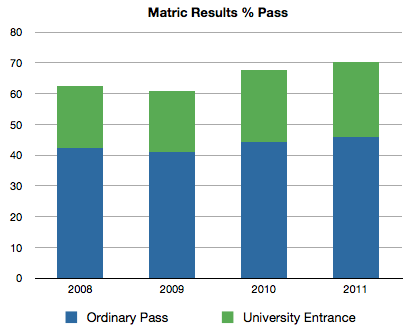
South African students will breathe a sigh of relief tomorrow morning as the 2011 Matric results are released. This evening we got the summary data, and in general the numbers are good. 70,2% of state-school candidates passed (up 2% from 2010) and 24,3% gaining university entrance (up just under 1%).

Students attending independent schools (which sit the equivalent IEB tests) performed exceptionally well. Of the 8 285 candidates, 98,4% passed and 85,5% obtained university entrance.

To make sense of these results I gathered government data for the last four years:

Matric pass rate, per year (Overall pass rate and university entrance obtained, respectively):

  • 2008: 62,5% and 20,2%
  • 2009: 60,7% and 19,6%
  • 2010: 67,8% and 23,5%
  • 2011: 70,2% and 24,3%

On the surface these statistics paint a picture of rapidly improving standards. However, given the pressure on government to both prove the value of the “new curriculum” and improve performance - especially in rural South Africa - one must ask the poignant questions.

Is the difficulty of final examinations being gradually reduced to improve performance? Are marks being adjusted upwards to compensate? And, critically, are school-leavers educated at a level to indeed enter university or adequately equipped find a job after school?

Update: NGO Equal Education highlights a concerning reduction in the number of candidates: 496 090, down 41 453 from 537 543 in 2010. They also note that 923 463 learners started Grade One in 2000 indicating an approximate 46,3% drop-out rate over twelve years of schooling.

Sources:

Taking Note

Let’s talk about how we go about remembering stuff with a few simple (and free) tools for the Mac, PC, Web, and iPhone/iPad.

  • How many times a week do you forget your online banking credentials?

  • How often do you find yourself surrounded by scraps of paper covered in scribblings?

  • When last did you actually scan and file notes from your last telephone call or minutes of a meeting?

  • Ever just wanted to jot down a few words in a safe place as you think of them?

  • How do you remember the list of items you need to discuss with Joe when next you meet?

If you’re anything like me, paper just doesn’t work for such moments. If I don’t lose that scrap of paper between the office and home, I’ll almost certainly forget to scan and file it for later retrieval. People like us need “a system”. Here’s mine:

Storage

Everything I write gets stored in one or more text files. You’d typically open such files in TextEdit or Notepad. As of today, my notes directory contains 433 .txt files. This gives me the freedom to open access my notes in any application I choose and the peace-of-mind of not being tied to a single piece of software.

Desktop Writing

This is where the magic happens. What we want in a note-taking application is the ability to quickly and efficiently search for information. I’d like to introduce you to two applications: NotationalVelocity (for Mac) and ResophNotes (for Windows).

NotationalVelocity was developed in 2002 by software developer, Zachary Schneiro to solve his problem of tracking short, unrelated snippets of information. Resoph is a great alternative for Windows users that works in a similar way.

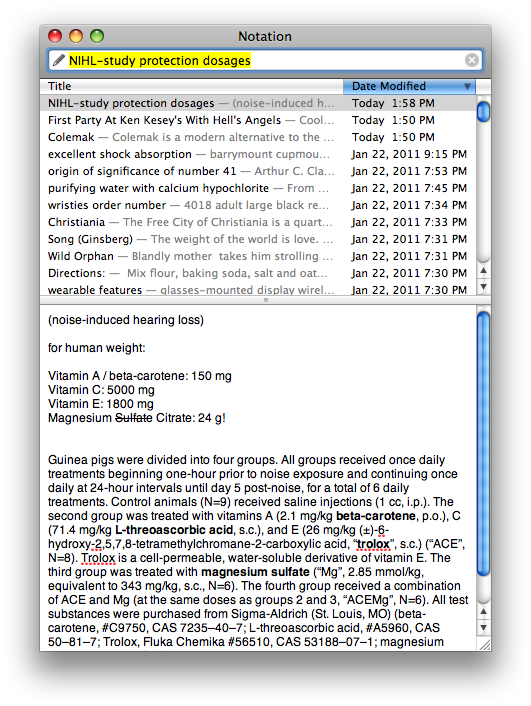
Let’s divide the user interface into three parts, top to bottom:

  1. Text field (highlighted in yellow, below),

  2. a list of notes sorted by their last modified date, and

  3. the text editor.

The Text field has the uncanny (and awesome) ability to both search and create notes. As you type, a full-text, incremental, live search is done across all of your notes. That is, within both the filename and file contents. If you hit Return (or Enter) at any point, you generate a new note with its title set to whatever you just typed. From there, the cursor is automatically moved to the third area - the note editor, and you just start typing your note. It feels incredibly natural.

The list of notes shows every note in your notes directory - along with a preview of their contents and date last modified. As you search, this list will update in realtime to show matching notes.

Notational and Resoph also save automatically as you type, so you’ll never lose a note again.

Syncing

But what use is a folder of notes on one computer? We need to get our notes onto “the cloud” for safe keeping and easy access. Enter SimpleNote.

SimpleNote is an online note-syncing service that automatically syncs with NotationalVelocity and ResophNotes. Simply sign-up for a free account and give Notational or Resoph your username and password. In next to no time, you’ll have access to your notes offline and online.

Going Mobile

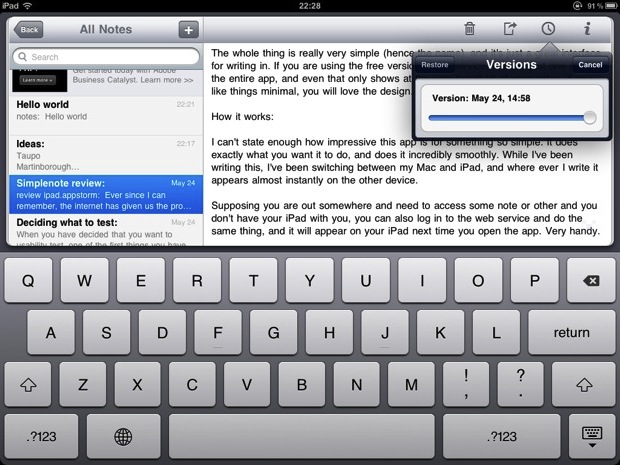
And it get’s better: If you have a iPhone, iPad or iPod Touch, you can download the SimpleNote iOS app (again, for free) and have access to all of your notes - complete with searching and tagging. This is great for note-taking during meetings, conferences and calls.

So, go and get that set up and let me know how it goes. I’ll post some power-user tips in the coming days.

The next three

Three years seems to be a familiar cadence in my life: three years of junior high, three years of high school, three years of university, and so on.

This last year was the best and most difficult year I’ve had. But it’s also been incredibly rewarding. Today marks the end to another three-year period which began when I joined Umoya at the end of 2008.

In that time I’ve got to:

  • build staffroom and provide services to 30 local schools,

  • design uniti and have it used in the 2012 Soccer World Cup,

  • deliver FireWeb to fire stations and wild-fire agencies throughout the country,

  • speak at Microsoft TechEd Africa and various other events,

  • start EdTechConf with my co-founders and appear on radio and in the media,

  • and share Cyber-safety workshops with kids, parents and teachers at schools around South Africa.

All this while getting married, buying a house, and fulfilling my role as a shareholder and development manager at Umoya. It’s been a period of giving love and attention to a range of projects and activities. I’ve learned a lot.

But, as you can probably imagine by reading the above, it’s lead to me attention-switching between four or five significant projects each day. Enough. I think I’d rather be great at one or two things, and not simply good at many. It’s time for some changes.

Earlier this month I wrote down three bullet points on a scrap of paper:

  • Reduce the diversity of my projects,

  • increase the depth at which I engaged in each of them, and

  • focus on projects that are aligned to my passion.

Finding my passion

My entire family are teachers. Literally. Grand-mother, father, mother, brother, wife, mother-in-law, and aunt. I’m surrounded by them. Ironically, I made a concerted effort not to go into teaching. I guess you can’t go against your genes.

Starting EdTechConf this year has been nothing short of life changing. I’ve been privileged to work with several schools - from private schools in Grahamstown to under-resourced schools on the Cape Flats. Across the board the cry is clear: “We seem to be losing learners to the realities of the 21st century.”

Poor schools are unable to provide teachers, classrooms and textbooks to learners while wealthy schools can’t pique the interest of digital-native-kids who expect a learning experience that is aligned with their multimedia lifestyles.

Thankfully there are solutions. And some of them involve the marriage of my expertise and passion - namely, technology and education.

I think the future of learning is the intersection of technology and education with the creative arts. I hope to dedicate the next three years to figuring out what this looks like, and how we deliver it to those who need it most.

Product

So, we’re doubling down on staffroom. We think its brilliant, and our users say that its a massive time and stress reducer. This year we’ll ship staffroom v4 - a beautiful redesign of the staffroom interface with several new and hotly requested features.

Then it’s time to move beyond school admin and assessment. We’ve been quietly working since June 2011 on something new, which I can not wait to show you. It’s called Umoya Funda and is already being rolled out at two pilot schools in Cape Town. A lot more on this soon.

Writing

I’ll be writing in greater quantity on a smaller range of topics. Given my purpose statement above, expect posts about Tech, Education and Learning. Some posts will simply be links, others will be short commentary on something topical, and others will be long form (like this tome). I’ll provide independent RSS feeds for when you want to skip the links and just get the long stuff, or vice-versa.

I’ve set a goal of 52 posts in 2012 and I fully intend to meet that. Hold me to this.

Talking

I love sharing ideas. This year we’ll run more EdTechConf events - hopefully in many more cities. We already have four local events confirmed and expect to add several more through the first quarter. We’ll also be announcing EdTechConf ThinkShops - one day workshops on particular topics for school leaders, teachers, and parents.

I’ve also embarked upon a personal project to produce a podcast. It’s going to be casual, informal, and hopefully useful to people. Think of it as a spoken version of what I’ll be writing about, along with interviews of friends and interesting people in the education and technology industry. I’ve acquired most of the neccesary studio equipment, hired a producer, and began lining up guests. I hope to begin broadcasting in mid-January.

tl;dr

So in short, I’m making the change from “Software Guy” to “Education guy that makes software”. I’ll still be advising the Uniti and FireWeb development teams at Umoya, but my primary focus for the next little while is going to be on staffroom, UmoyaFunda, EdTechConf and education in general.

Here’s to an exciting new chapter, 2012. Happy New Year.

My Gran

That’s my gran right in the middle. She passed away last night.

We all thought it was coming. She certainly knew it was. Still, incredibly hard to realise.

I have more memories of my gran than I could possibly write down, but two will stick with me for the rest of my life.

The first was about ten years ago. Gran was a few years into her heart problems and had begun to pack up her house. Each visit brought with it more trinkets and whatnots to be handed-out to all and sundry. One day, at such a gathering, someone asked her why she was getting rid of almost everything she owned.

“Well I don’t think I’ll be around much longer you see.” Silence. “Oh, you can’t think like that.” “No no, I’m really quite comfortable with it”. There was a glimmer of keen longing in her eyes. “The Lord has a place for me and I’m really looking forward to meeting Him.”

I’ll always remember that my gran never feared the end of her life. In fact, she was quite comfortable with the very tempory nature of her time here on earth. More comfortable with it than anyone else I know.

The second memory is more recent. It was late afternoon on December 19th, 2009 and Amy and I had just been married. We were about to walk out from the dining room to our guard of honour before driving off on honeymoon, when we saw my gran still sitting at the very back of the room.

By this time her mind had gotten foggy and she wasn’t entirely sure about her surrounds. She must have been exhausted after a whole day out, but as we walked back across the room her eyes lit up. As we sat down she looked at us and said “Thank you for a lovely day. I feel so priveleged to have been invited.”

I’ll always remember her kindness and humility. And I’ll remember her inner, God-given peace.

Even as her mind let her down and her body became frail, she never complained about her ailments. Nor did she ask people to pity her. She took it in her stride and kept her eyes on the goal.

So, farewell and congratulations Gran. You made it home. We are so happy for you.

Mac Apps 2011

Having upgraded my Macbook Air the day OS X Lion came out, I settled down a last night to upgrade my main machine – my 2010 MacBookPro.

Plenty of people have already posted best practices for upgrading to Lion, so I won’t do bore you with a detailed explanation of backing up with TimeMachine and Superduper.

What I did find fun, was making a list of those Apps that I use on a daily basis and will need to install before I can be productive. Hopefully you’ll find some gems listed below that’ll help you in your day-to-day Mac workflow.

Productivity

Development

Design and Photography

Social

Gaming

Unix Nerdary

Teachers mull technology in education

Michelle Jones, Cape Times, reports:

The conference, held at the International School of Cape Town in Wynberg, was attended by 110 delegates from more than 50 city schools. Tim Keller, an organiser, said by referring to cellphones as “mobile learning devices” mindsets could be changed about their use in classrooms.

Amazing response to our little event in the last month. It looks like we’ll be doing it again sooner than we thought.

Special Knowledge Butterflies

Flying poses some challenges. It requires at least an hour-long process of security, and baggage checks… not to mention the cost of the obligatory cuppachino while one waits for the gates to open. Boarding is followed by a further 30-minutes of thumb-twiddling while the cabin crew apparently “arm doors and cross-check” (which I still don’t understand).

Nevertheless, I love flying.

The two hours between Cape Town and Jo’burg means no phone calls. There’s absolutely zero chance that anyone can make my phone ring. No amount of conviction or persistence on the part of the callee will result in my phone shouting at me. It means no email - and it means that there’s nothing I can do about the few hundred messages that are waiting for me to respond, archive or defer.

Bugs can be reported, features may be requested, servers can explode, but I’ll be inoculated in my green hurtling fortress of solace.

Thinkers from Uber Productivity nerd, Merlin Mann, to SaaS guru and 37signals founder, Jason Fried, have expounded at length about the crisis unfolding in the post-knowledge workplace. One in which we react to the issues as they arrive, rather than proactively harvesting the completion of well planned activities. One in which there is so much extraneous noise the we end up time-division-multiplexing our work into ten second sprints, eventually finishing few of them, and being absolutely not great at any of them.

Don’t get me wrong. Reacting to incoming issues in the workplace has it’s place. Especially if you’re a Fireman, Neurosurgeon, or Air-traffic-controller. However, post-knowledge workers (who, by the way, are borderline ADHD by design) need a distraction-minimized environment where they can cultivate and harvest their creative outputs regularly.

How many creatives do you know that conduct their work behind iPod headphones? They’re not doing that because they’re into music. They’re doing it because they’ve found a plausible way to deny distraction. I many cases, they’re just listening to silence in the hope that the visual message of wearing the headphones will preclude the need to respond to whether they think that office birthday cakes should be chocolate or vanilla. Plausible deniability. What a life.

They need serial challenges which offer significant dopamine return upon completion. And this completion is not reached when the task is extinguished. Oh no, this task is complete when the post knowledge worker feels that they have just delivered the best work of their life. The post knowledge worker can feel the elation of great work coursing through their veins.

Yeah. We’re a pretty complex lot.

The worst thing you can do to your post-knowledge workers, is lead them to believe that your project-schedule is more important than the excellence of their work. Yes, you’ve got to ship. But what use is shipping, if your rushed product isn’t excellent? Ask any company of post knowledge workers that actually produces excellent output - Apple, Blizzard Entertainment, Pixar or Valve. They favor Not Shipping over Shipping rushed work. And so should you.

I was more productive today than I’ve been all month, because I spent 4 hours on a plane, without a connection to the world. How productive would your team be if you gave them the best environment to work in, and the trust to make them feel like the special butterflies they (think they) are?

Learn, Unlearn, Relearn

The illiterate of the 21st century will not be those who cannot read and write, but those who cannot learn, unlearn, and relearn. - Alvin Toffler

Art Preston’s post concerning “The Grading Conundrum” once again raises the debate of how we measure and assess our school students. South African schools have been through a whirlwind of change, re-change, and - sadly- un-change in the last two decades. It is clear to me that teachers, our nation’s most endangered resource, are disillusioned and fatigued.

This instability of assessment standards has lead to a gross instability in the quality and manner of teaching across the country.

The complete lack of consensus on assessment standards and methods is clear to us every day at staffroom. Every new school we sign-up has a different approach, and our system has become very good at being flexible to their needs. These staffroom schools are some of the best in the country. If they can’t reach consensus on how to assess, who can?

In thinking about assessment there are, of course, two extremes - a heavily quantitative method resulting in a percentage rating per student, and a heavily qualitative approach whereby students are assessed on competence and demonstrated ability.

As a Computer Scientist, I do value the quantitative aspects of data.  When I taught IT to High Schoolers - my fancy Excel spreadsheet (later, staffroom) calculated their overall average percentage for that course. It was trivial to bin my class into percentile brackets and understand how I was doing in terms of the expected bell curve.

But for many parents, the typical “59% for Mathematics, 61% for English, etc.” report leaves them wondering what they are doing wrong with their child. Many students will tell you: “I’m really good at Algebra, but I just can’t do Geometry. So I got 80% for Algebra, but only 39% for Geometry. That’s why I only got 59%.” That 59% for Mathematics tells the parent nothing about their child’s particular strengths and weaknesses in the subject.

And, no, mapping a 1 to 7 code/level scale to these percentages instead of A+ to F- does not help.

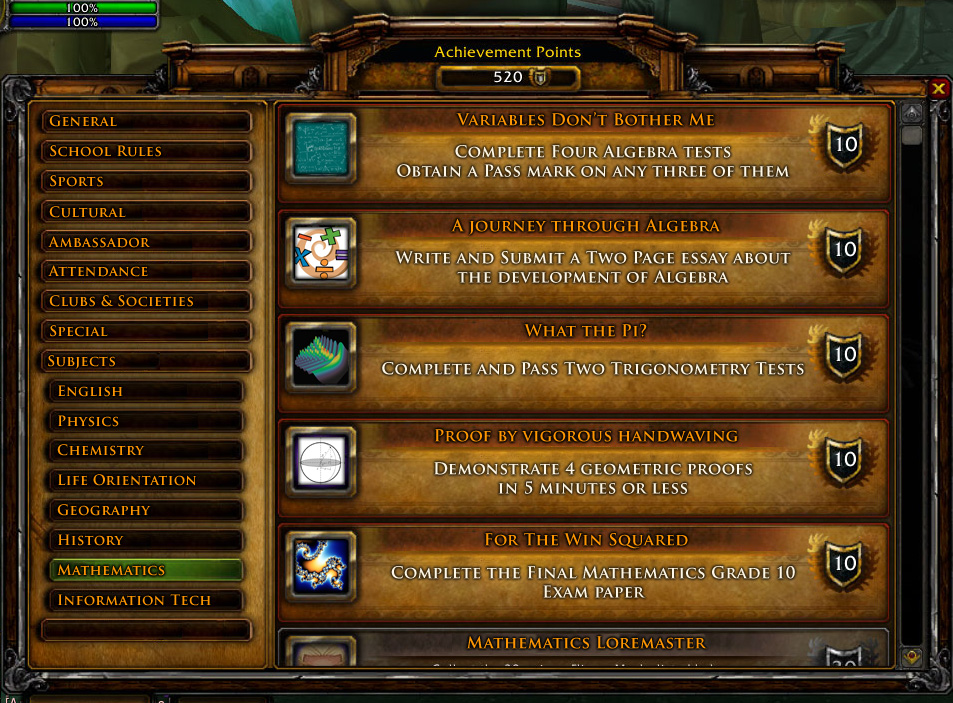
If World of Warcraft has taught me anything, its that kids (okay, and adults) crave achievement. There’s nothing better than finishing a dungeon and seeing that golden achievement pop-up on your, and your guild’s, screen congratulating you on the effort. You carry that achievement with you for the rest of your character’s existence in the game.

If students were as motivated to achieve in school, as they are in Warcraft, they would do a whole lot better. And, again, no - the current farce that is annual school prize-giving (in which everyone gets a certificate regardless of effort) is not sufficient. I believe Achievements must be rewarded immediately.

In the age of transparency, students and parents want measurable data and facts. They want to see their current status, and see simple step-by-step action plans to success.

Imagine if our students’ report cards looked a little more like this:

Report Card 2.0

Schools seem to be in the business of helping students to unlearn what they pick up in the real world of cell phones, games and facebook. What if, rather, our schools unlearned their 19th century habits, and relearned what 21st century students need to get out of the education process. Let’s embrace our students’ world.

In the 21st century, education is about project-based learning, connections with peers around the world, service learning, independent research, design and creativity, and, more than anything else, critical thinking and challenges to old assumptions.

  • Prakash Nair

Married

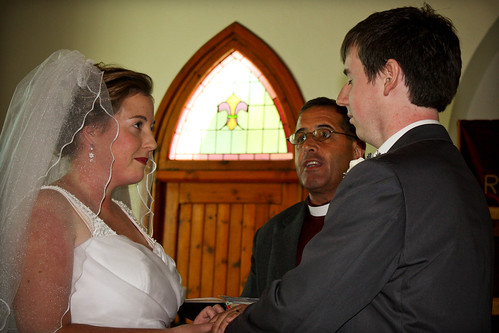
Wedding Day - GK-049

19 December 2009: Amy and I get married at Simon’s Town Methodist Church

Our official photographer will be turning in her beautiful images this week, but in the meantime I thought I should get just a couple of pics from the day up! Thanks to our family and friends for capturing some truly special memories for us.

First and foremost, thank you to all our friends and family who joined us on the 19th. Your presence – and presents – were most appreciated!

Getting married is just about the most exciting, scary, complicated and wonderful event you’ll ever experience. The sheer number of things which need to come together on the day is quite astounding. Invites, guest list, seating plan, dress, suits, flowers, cars, pastor, mariage contract, marriage counseling, traveling friends/family, Honeymoon booking, speeches, lunch/dinner, cake, photographer, videographer, and rings - its all quite something.

Happy New Year and welcome to 2010.

Engaged

I’d like to formally announce that Amy and I are engaged, and we both couldn’t be happier!

On December 24th, 2008 I picked Amy up after work and took her to Kirstenbosch Botanical Gardens for a picnic. It was perfect. I had the ring hidden safely away in a bag, a one-of-a-kind 18ct Yellow Gold and 0.56ct Diamond ring which I had only collected from the designer that morning!

We climbed a particularly beautiful rolling hill of lawn and threw a picnic blanket down. She had not idea of what was about to transpire.

Several minutes later, to the surprise of Amy and several picnic’ers who had watched me get down on one knee, I had a fiancé! I called our waiting parents who had been hiding out, awaiting our call. They brought up large amounts of Champagne and we toasted the best day of our lives thus far!

Don't Buy a Renault

I bought a Renault Modus in October 2005. All was fine for the first year until my latest service, the 30 000km service. For starters, the service cost me R1400 for labour… which is well above industry standard for 2007. Then I was told that my front brake pads needed replacing, that was another R900. Then I was informed that my tires needed to be replaced urgently. That’s were the major issues started.

You cannot get tires for the Renault Modus in South Africa. Even Renault themselves admitted that they can’t get tires! A three week search ensued resulting in 1 tire found in Uppington and another 2 in Johannesburg. Those were joined by my current spare tire and finally fitted today at a cost of R2000. But how can every Renault owner undergo this process each time they need to replace the tires. A friend of mine’s mother has been waiting since April 2006 for a new spare tire for her Renault Senic. Come on Renault.

Next issue… At my service I was informed that my car’s alternator was flawed and had been since it left the showroom, but that they would get parts for it as soon as they good. That would explain the really odd sound I’d heard since day 1 but always thought to be part of the “Modus sound”.

After two weeks I got the new alternator and tension pulley installed free of charge (amazing) and I was phoned at 3pm to collect my car. After work (4:30pm) I had a friend take me down to collect – only to be told “Sorry, your car is out on the road test. Just wait a minute.”

I wasn’t offered a seat or a cup of coffee so I stood on the service department floor waiting for my car to get back. When it did I was just given my keys and shown some control certificate thing. That’s it, no apology.

I drove off and about 10 minutes later realised that not only was the sound still there – but it was far worse than ever before.

I contacted them today to tell them how unhappy I was and was told “okay, we’ll have someone call you on Monday about it”.

Sigh. Come on Renault.

Update – Jan 2011: This continues to be a popular post here on my blog. Thanks for reading it! In Jan 2008 I finally got rid of my Renault Modus by trading it in to Barons VW. I had to pay in several thousand Rand to settle the outstanding amount owing on the loan. Oh, and almost fours years later, I’m still waiting for Renault to phone me back. Please, don’t buy a Renault.

Loading more posts...
That's all, folks.